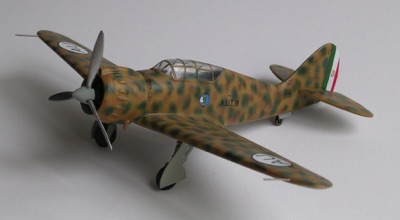
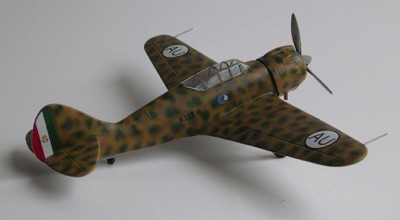
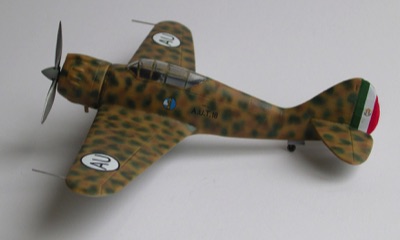
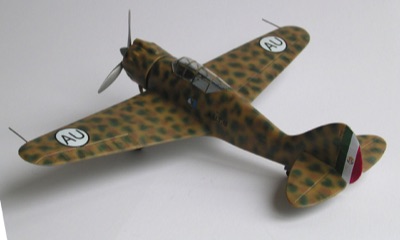
Originally built for SAMI and appeared in the November 2004 issue.
The Kit.
This is essentially the same kit as the previously reviewed AUT18, the only difference being the revised cowling design, which was an ill-starred attempt to improve aerodynamics of the protoype. It was restyled in a similar fashion to other radial engined aircraft at the time, such as the Caproni Vizzola F.5 and Macchi C.200, i.e: a reduced diameter cowl with fairings over each cylinder. The other "alteration" was the application of a mottled camouflage scheme. In all other respects the kit is identical, even down to the decal sheet. What this means is rather crudely moulded injection parts which require a fair amount of cleaning up, as well as the variable quality of the engraved panel lines on the vacuum formed pieces. The instruction sheet has the same simple, easy to follow layout, the difference this time being the markings diagram showing the familiar Regia Aeronutica mottled scheme.
Instructions.
The A4 sheet has a hand drawn parts layout and assembly sequence on one side and a markings guide on the reverse. FS numbers are given for all the colours used, with Humbrol equivalents. There's no history, but dimensions are given.
Construction.
First task was to remove all the parts from the vac-formed sheets. Having already been through this procedure once before, it was quickly done. After a clean up of the injection moulded pieces (and thinning out trailing edges of the vacu-formed parts), they were soon ready to assemble. The cockpit is a very simple affair, just a vac-formed floor, instrument panel and rear shelf, which all needed trimming to fit (the seat and stick can be added later). After joining the two fuselage halves together, the one piece lower wing is offered up next. The two upper wing halves are carefully trimmed and test fitted before assembly. As before, some filler is needed to smooth out the wing to fuselage join. The stabilisers are the last major components to be added.
The cowling made up out of the now familiar combination of vacform/injection parts. Unfortunately, the detail of the cowling bulges themselves are a bit indistinct and even after a small amount of filler and careful trimming, it did little to improve its overall appearance.
The solid canopy on the fuselage was then carefully removed, the seat and stick added and then the carefully trimmed clear vac-formed piece offered up to check the fit. Despite the rather crude framework, masking the canopy was quite straightforward, using the plans on the instruction sheet as a guide.
The undercarriage is a big disappointment. With better references to hand this time around, it is clear they are nothing like they should be, being very flimsy and poorly moulded. I made new doors out of thin plasticard and raided the spares bin for better undercarriage legs. I adapted Sector G.50 units, making new forks to hold more accurate tyres found from spares to replace the shirt-button type kit parts.
The engine detail is poorly done and the propeller is not very good either. I replaced the prop but retained the engine. The spinner was not very well moulded and is far too small. It ought to be replaced with a much larger spinner (almost 50% bigger!).
Accuracy.
Published dimensions given are for a span of 11.5m, a length of 8.75m and a height of 8.75m. The kit scales out almost spot on, being slightly short on span and a tad over on the length. It neatly captures the rather graceful appearance of the aircraft.
Colour Options.
After being silver overall initially, this prototype was given a three colour mottled scheme after modification. I used Humbrol paints throughout, using 63 as a base, applying mottles of 149 and 118. The lower surfaces were 140. Future was used to give a good base for the decals.
Decals.
A very simple sheet that was no problem to apply. Rating 9/10.
Conclusion/ Recommendation.
The mottled scheme definitely favours this model, as it helps to mask the various moulding defects that were painfully hi-lighted on its early overall silver incarnation. I would recommend this kit on that basis alone, especially those who do not enjoy recreating a NMF on their models. It is a reasonably easy model to construct and would be a good start for those not familiar with vac-form modelling. Recommended to all Italian aircraft enthusiasts.
Many thanks to Broplan for the review sample.