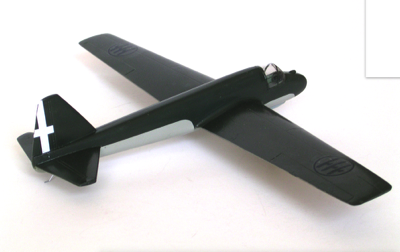
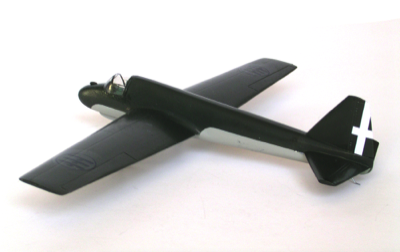
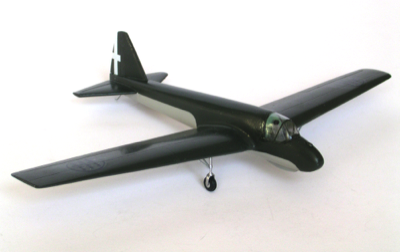
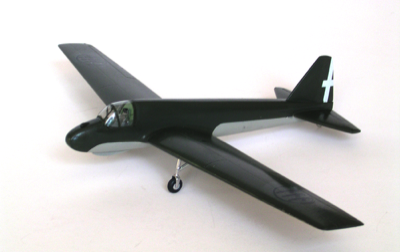
AV Models Avia LM-02 built for a SAMI review in 2005
The Kit.
This resin model of the 1942 Avia LM-02 glider bomber prototype came in a plain white sturdy cardboard box, with a yellow paper label glued on the lid. Inside all the resin pieces were in sealed bags, as were the white metal undercarriage, decal sheet and two vacform canopies. The overall quality of the resin pieces are not that great, although no air bubbles were present. The trailing edges are quite thick and when viewed from the front, the tail surfaces bulge out towards the midpoint! There are very thick trench like panel lines engraved on the wings. The smaller detail parts, such as the aileron mass balances, are rather crude and the dive brakes are moulded on a fairly thick backing sheet. This means the only way to remove them is by sanding the sheet away rather than trying to cut them out. The white metal undercarriage legs have a rather pronounced seam and the vacform canopies look very fragile, being blown out of quite thin clear stock. There is a short length of wire with which to make support struts for the undercarriage legs.
Instructions.
A single A4 sheet is provided. One side has a single hand-drawn exploded assembly diagram that's not too clear for positioning some smaller items, as well as a small grayscale illustration of the side profile and an even smaller top and base view of the wing. Two blurry photo images of the real aircraft are shown as well. The other side has a rather more useful 3-view plan, although the dihedral is in conflict with the photo image.
Assembly.
The level of cockpit detail is rather basic. It includes a floor, a seat with headrest, stick and rudder pedals. A crude instrument panel is enlivened with a basic printout of the dials. The rear bulkhead moulded in with the seat is far too small to fill the fuselage cavity, so I made a new one out of card, blending it in with filler. The two fuselage halves fit together reasonably well but filler is needed to get a nice smooth join. The two solid cast wings are more difficult to align properly. They certainly do not go on first time! Several test fittings were needed to get the correct alignment, using the photo image to judge the correct dihedral, but also referring to the plan view to ensure the trailing edges of the wings are at right angles to the fuselage centre line. More filler was used on the wing fillets to blend in with the wings. At the same time I filled the heavily engraved centre panel lines on the wings. The bulged tail surfaces were sanded down to a more accurate shape and then butt joined to the fuselage, although there is conflicting information to the positioning of the horizontal surfaces. The illustrations have them placed away from the fuselage end, but the plans have them aligned with the end. The photo image is too indistinct to decide either way. The rest of the small detail parts are confined to the wing lower surfaces, this includes the undercarriage, dive brakes and aileron mass balances, as well as the two bomb racks and landing skid. I omitted the bombs as they are not the correct type. The wheel were moulded out of alignment so I used spares. The cockpit canopy was a very nerve wracking part of the construction. Having been vacformed from thin clear stock, it was very easily damaged if not handled carefully. It was also very difficult to trim accurately enough to fit the cockpit opening. I did managed some sort of fit in the end but was not too pleased with the final result. Masking it ready for the camouflage application was also a delicate operation.
Accuracy.
The kit measures 223mm in span, 149mm in length and 39mm in height. Against the dimensions given on the instruction sheet, the kit is spot on in all dimensions. Judgement of its overall appearance is hard to call, as very little can be gleaned from the two images provided and I could not find anything else to compare it with.
Colour Options.
As far as I'm aware, this was a one off and had the late WWII camouflage of overall dark olive green with pale grey under surfaces. The unusual demarcation line is non-standard and is probably unique to this aircraft. There are no squadriglia code numbers or even insignia, just wing roundels and a rudder cross. I used Xtracolor X109 for the green and X134 for the lower surfaces.
Decals.
This very small but fairly well printed decal sheet that was easy to work with. There were no problems applying them to the model. Rating 8/10.
Conclusions/Recommendations.
This is not as simple and as straightforward a construction as one would expect for a glider model. The overall quality is not to the standard that's possible in this medium. It's main appeal, I suspect, will be the curiosity value of it being a glider-bomber. That alone lifts this model out of the ordinary and is the only reason why this model earns a cautious recommendation.n
Many thanks to AV Models for the review sample.